Showing posts with label Hyundai. Show all posts

Monday, November 30, 2009

Hyundai Equus


If you think the Genesis sedan is nice, wait'll you get a load of Hyundai's home-market luxu-flagship, the Equus. The automaker has one prominently on display here at the New York Auto Show this week, and while it's supposed to merely be a "Look, this is how awesome we can be" thing (there's no plan for the Equus to be sold here at this time), you can bet Hyundai is taking note of people's reactions. Outside, the Equus is more ornate than the Genesis, with a bright grille, highly-polished wheels and a pedestrian-impaling hood ornament. The sheetmetal details are nice, too. We especially dig the subtle fender bulges over the rear wheels.

While that's all well and good, it's inside the cabin where the Equus shows that it's truly meant to do battle against the likes of the Mercedes S-Class, Lexus LS and BMW 7 Series. All the toys are present: push-button start, a console-mounted control interface for the in-car systems, classy wood accents, upmarket switchgear, and even Grey Poupon snack trays for the rear passengers. Oh, those rear passengers get massaging back seats, as well. It's very impressive looking and it stinks of quality. If Hyundai ever decides to gamble and attack the next price segment up from the Genesis sedan, they clearly have the ammo to do so. The Equus is the real deal.

Hyundai Equus to be offered in bulletproof spec


In political circles, what you drive -- or more accurately, what you're driven in -- matters. For proof, look no further than the custom-built, tank-like Cadillac that President Obama is chauffeured in. Could you imagine the Commander-in-Chief riding around in the back of an automobile carrying a German logo? Unfathomable. But in Korea, its common practice for politicos to be driven in vehicles built abroad since no domestic automakers offer a bulletproof, executive-class vehicle... yet.

Korean President Lee Myung-bak has apparently requested that Hyundai rectify that unfortunate situation by manufacturing a bulletproof sedan for key governmental figures. The new sedan is currently in development and will reportedly be based on the upcoming Equus large car platform. Until this new vehicle is ready, President Myung-bak will make do with his current fleet, which consists of the Mercedes-Benz S600 Pullman Guard and the BMW Security 760Li.

[Source: Digital Chosun Ilbo]

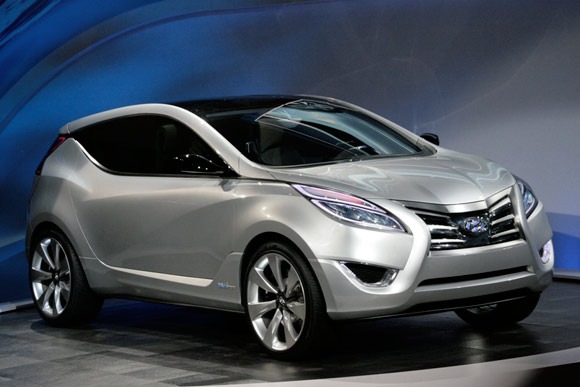
Hyundai Nuvis concept hints at next-gen CUVs


The first hint of what we can expect from the next generation Tucson and Santa Fe crossovers was revealed today at the New York Auto Show as the Hyundai Nuvis concept. The sweeping creases echo and expand upon Hyunadi's design direction that could be seen on the Genesis coupe and sedan and the Korean market Equus that stood on display nearby. Like so many other concepts at the show this year, this one featured doors that will almost certainly not be duplicated in production, extra-long gull-wings in this case.

The interior is designed for exactly four occupants instead of going for the maximum possible seating with three rows. Nuvis designers have dispensed with all the usual switch gear in favor of a river of information flowing throughout the concept's interior, all of which is accessible through touch-sensitive surfaces. All of the interior fabrics are also made from 100% recycled materials.

Under the skin, the Nuvis is spec'd out with the same Hyundai-developed BlueHybrid drivetrain that was shown at the LA Auto Show last November. The hybrid system uses lithium polymer batteries, which give designers more flexibility in packaging compared to more typical lithium ion batteries. The production version of this hybrid system debuts next year in the next-generation Sonata, while the design elements of this concept will likely appear on the new Tucson later this year.

Hyundai ix-Metro concept


Hyundai returned to Frankfurt a far bigger player than it was two years prior. The Korean company has leapt up the sales standings to become the world's fourth largest automaker, eclipsing such major players as Ford and Honda. And its product line has long since expanded from diminutive hatchbacks to include crossovers and luxury sedans. What better way, then, to mark its newfound stature than to unveil... a diminutive hatchback/crossover thing?

Of course, Hyundai also unveiled the new ix35 Tucson, but presented along side was the automaker's vision for a compact hybrid. Called the ix Metro, it may be about the same size as the Geo that once bore the same name, but packs more curves and creases into the same plot of real estate than a linen mill. Curiously, Hyundai hasn't provided any details on the electric component of the hybrid drivetrain, but the conventional side of the equation boasts direct injection, variable valve timing and a turbocharger in a tiny 1.0-liter three-cylinder engine, driving through a six-speed dual-clutch transmission.

PRESS RELEASE:

Hyundai's Eco-Technologies and Products on Display at 2009 Frankfurt Show

Frankfurt, Germany, 09/15/2009
• ix-Metro, a daring new Hybrid Electric CUV
• i10 electric zero-emissions vehicle
• European debut of ix35

At the 2009 Frankfurt Auto Show today, Hyundai Motor Co. unveiled two important eco-friendly cars in a display of its commitment to improve energy efficiency and to lower greenhouse gas emissions of its vehicles.

Making its world debut was the ix-Metro, a daring new Hybrid Electric CUV for the European sub-B segment. Emitting just 80g/km of CO2, the ix-Metro is powered by an inline three-cylinder petrol engine displacing just one-liter. Direct injection, dual CVVT, and turbocharging are combined with a six-speed dual clutch transmission to make for a highly potent compact package. It's the fifth in a series of concept cars to be created by the Global Design Team in Namyang, Korea.

The other global premiere was the i10 Electric, a production-ready zero emissions vehicle. Powered by a 49kW motor and a 16kWh battery, the i10 Electric promises a driving range of 160km and top speed of 130km/h. It features x-by-wire systems for steering, air conditioning, water pump and the brake vacuum pump. The i10 Electric will see limited series production start in Korea in 2010 for pilot fleet demonstration purposes with government ministries, utilities and related agencies.

In his address to the audience which gathered to catch the unveiling of the two concept cars, Hyundai Vice Chairman Euisun Chung said: "Blue Drive is all about bold new thinking, about listening more carefully to what consumers are saying and what they really want. Our declared goal is bold: It's to be the industry's eco-leader."

These and other new eco-friendly models were on display in the Blue Drive Zone at the Hyundai booth. The Zone also included the Elantra LPI Hybrid and the Blue Will Plug-In Hybrid Electric concept vehicle. The Elantra LPI is the world's first hybrid electric vehicle to be powered by liquid petroleum gas (or autogas). Emitting just 94g/km of CO2 (European combined mode), it's also the first production car in the world to be powered by advanced lithium ion polymer batteries. A new Blue edition of Hyundai's highly popular i30, designed in Germany and built in the Czech Republic, was another highlight of the Blue Drive Zone. Featuring fuel-saving stop-and-go emissions reduction technology, the ISG system contributes towards a reduction of 7% in fuel consumption and vehicle emissions on the official combined cycle, compared to the standard cars. Tests have revealed a drop in CO2 emissions of up to 15% in heavily congested traffic.

Visitors to the Hyundai stand at Hall Six in Frankfurt Messe were the first to get a closer look at the ix35, the European version of the all-new Tucson which made its debut in the Korean market last month. Designed in Europe and to be built in Europe, the ix35 is the first production vehicle expressing Hyundai's new "fluidic sculpture" design language. It's fitted with the all-new R 2.0 diesel and six-speed automatic transmission.

Also on display was the updated Santa Fe which will provide fresh momentum to the CUV sector. It is fitted with a 2.2 version of the all-new R diesel and comes with the option of the new six-speed automatic.

Established in 1967, Hyundai Motor Co. has grown into the Hyundai-Kia Automotive Group which was ranked as the world's fifth-largest automaker since 2007 and includes over two dozen auto-related subsidiaries and affiliates. Employing over 75,000 people worldwide, Hyundai Motor sold approximately 2.8 million vehicles globally in 2008, posting sales of US$25.6 billion on a non-consolidated basis (using the average currency exchange of 1257.5 won per US dollar). Hyundai vehicles are sold in 193 countries through some 6,000 dealerships and showrooms. Further information about Hyundai Motor and its products are available at http://www.hyundai.com

Hyundai Genesis Sedan - The most awarded car of 2009?


When the Hyundai Genesis Sedan hit the scene, it was hard to know exactly what to think of the handsome-if-anonymous looking luxury intender. After all, Hyundai hadn't ever had a presence in our luxury car market, and attributes like rear-wheel drive and V8 engines weren't exactly a Hyundai staple. Over the past year, however, the Genesis' well-judged appointments and recession-friendly pricing Genesis Sedan won us over, and our contemporaries in the motoring press seem to feel the same way.

Hyundai says that the Genesis Sedan's considerable trophy case makes it the most awarded car of 2009 – and since we have no methodology by which to cross-checking such a high-falutin' claim (scientific or otherwise) we're going to give the Korean automaker the benefit of the doubt. The Hyundai Genesis Sedan began 2009 as the North American Car Of The Year and the well-heeled sedan has continued to build momentum with an impressive 21 awards. Among the Genesis Sedan's many honors are nods from Motor Trend (America's Top 40 New Cars), Cars.com, J.D. Power, NADAGuides, and AutoPacific.

Heck, the Genesis' 375 horsepower Tau 4.6-liter V8 also made Wards Automotive's 10 Best Engines list, and after putting down nearly 2,000 miles in just such a beast earlier this month, AB executive editor Paukert concurs, praising the eight's smooth power delivery and impressive mileage. Despite a packed cabin and trunk and plenty of mountain driving and high-speed cruising, our man averaged 26.1 MPG on a circuitous route from Michigan to North Carolina – fully 1.1 MPG better than the EPA says to expect on the freeway. He also praised the car's acheless seats and pleasing Lexicon audio system as excellent long-distance travel partners.

Hit the jump to read the press release listing the Genny's awards cache. What follows is a proud parent brag-fest, but when you get it right like Hyundai appears to have done with its Genesis Sedan, perhaps a little self-promoting is merited. Maybe now they'll see fit to finally take credit for it by putting a "Hyundai" badge somewhere on the car

[Source: Hyundai]

PRESS RELEASE:

Hyundai Genesis is class of the 2009 model year with most top-car honors

Headlined by the 2009 North American Car of the Year Award, Hyundai's New Flagship Earns More Top Recognition than Any Other 2009 Introduction

FOUNTAIN VALLEY, Calif., August 27, 2009 – Hyundai's all-new flagship, the Genesis sedan, launched to significant anticipation culminating with its coronation as the 2009 North American Car of the Year – the first time a Korean brand has ever achieved the honor. But Genesis didn't stop there, accumulating honor after prestigious honor to become the most decorated new car launch of the 2009 model year. At last count, Genesis tallied more than 20 top honors from the most prominent media outlets and automotive organizations in North America.

Genesis' trophy case includes awards and accolades from the likes of J.D. Power and Associates, Motor Trend, AutoPacific, Cars.com and leading consumer publications. Genesis is built on Hyundai's all-new, performance-driven rear-wheel-drive architecture. It offers two powertrains, the Lambda 3.8-liter V6 engine producing 290 hp, and Hyundai's all-new Tau 4.6-liter V8 engine producing 375 hp. With technology rivaling more expensive luxury sedans, convenience features like push-button start and navigation system, and five-star safety ratings from the National Highway Traffic and Safety Administration (NHTSA), it's clear that Genesis is among the best new cars of 2009. But at a starting MSRP of just $32,250 and max price of just $42,000 for a fully loaded Genesis, it's no surprise the competition was left in Hyundai's rear-view mirror.

"Genesis was developed to rival the world's best luxury sedans so we knew it would be a great car, but we didn't know how it would be received by the automotive community," said Scott Margason, director of Product & Strategic Planning for Hyundai. "As the awards accumulated, we realized not only how well designed the Genesis was, but how far the Hyundai brand had come. Consumers and automotive industry influencers really embraced the idea of Hyundai producing a luxury product."
Genesis Sedan Awards

1. 2009 North America Car of the Year
2. Motor Trend – America's Top 40 New Cars
3. J.D. Power and Associates – Automotive, Performance, Execution and Layout (APEAL) - Most appealing midsize premium car
4. J.D. Power and Associates – Vehicle Launch Index (VLI) - Highest ranked 2009 all-new or redesigned vehicle
5. The Car Book 2009 – Best Bet (intermediate category)
6. About.com – Best New Car
7. Kiplinger's Personal Finance – Best New Model (sedans $30,000-$45,000)
8. NADAguides.com – Car of the Month (April)
9. NADAguides.com – Top 5 Luxury Cars
10. NADAguides.com – Best Car Buy - Top luxury cars under $35,000
11. Autotropolis.com – Car of the Year
12. Cars.com – Car of the Year
13. On Wheels – Car of the Year
14. AutoPacific – Ideal Vehicle Awards - Aspirational Luxury Category
15. AutoPacific –Vehicle Satisfaction Awards - Aspirational Luxury Category
16. Consumer Reports – Top-Rated Vehicle (upscale sedan category)
17. Consumer Digest – Best Buy (luxury segment)
18. MyRide/Autobytel – Car of the Year
19. Ward's Auto World – 10 Best Engines (4.6 liter Tau V8)
20. Automobile Journalists Association of Canada – Canadian Car of the Year
21. Automobile Journalists Association of Canada – Best New Luxury Vehicle Under $50,000

HYUNDAI MOTOR AMERICA

Hyundai Motor America, headquartered in Fountain Valley, Calif., is a subsidiary of Hyundai Motor Co. of Korea. Hyundai vehicles are distributed throughout the United States by Hyundai Motor America and are sold and serviced through more than 780 dealerships nationwide. All Hyundai vehicles sold in the U.S. are covered by The Hyundai Advantage, America's Best Warranty. In addition, Hyundai Assurance is now offered on all new vehicles leased or purchased from a certified Hyundai dealer. The program is available to any consumer, regardless of age, health, employment record or financed amount of the vehicle. The program is complimentary for the first 12 months.

Hyundai Equus coming to the States in July 2010, priced under $60,000


According to an anonymous source at Hyundai, buyers in the U.S. will get their first crack at the Hyundai Equus sedan beginning next July, with a cost of entry somewhere south of $60,000.

The Genesis-based sedan, which stretches a little over seven inches longer than Hyundai's first attempt at entry-level luxury, is available in Korea with either the Genesis' 3.8-liter V6 or 4.6-liter V8. However, Stateside buyers will only be able to purchase the bent-eight model when sales begin next summer.

Hyundai's primary aim with the Equus is to compete with the similarly priced Lexus LS460 ($64,700), while offering more luxury amenities including reclining rear seats, massagers and LCD displays. According to Rick Case, the owner of six Hyundai dealerships in North America, "It won't be a volume model for us. It will be a halo car for the brand." If you want to scope out the Korean-market Equus before sales begin next year, 100 sedans are currently available for evaluation at dealerships across the country.

[Source: Autoweek]

100 Hyundai Equus sedans coming to U.S. dealers


The Hyundai Genesis sedan has won plenty of accolades since its introduction, and with just over 6,000 units sold so far this year (through April), Hyundai wants a bigger share of the luxury pie. So beginning this summer, the plucky Korean automaker plans to ship 100 Hyundai Equus sedans to the States for display at dealerships throughout the country in order to gauge public reaction. If it wasn't obvious after the Equus' North American introduction at the New York Auto Show, it is now: Hyundai desperately wants to bring the Equus to the U.S., but are Stateside consumers ready for it?

According to Oles Gadacz, a Seoul-based spokesman for Hyundai, the automaker believes the introduction of the Equus, "would decisively shift public opinion in our favor," even more than the Genesis sedan and its coupe counterpart.

While the Equus would go head-to-head with such luxury stalwarts as the BMW 7 series, Mercedes-Benz S-Class and Lexus LS460, it's price-point of approximately $75,000 (according to the USAToday) could still be too high for brand-obsessed buyers. However, the current economic climate could cause consumers to finally look beyond the badge and start considering alternatives that offer all the amenities available from the Germans and Japanese at a lower cost. But Gadasz admits Hyundai doesn't expect the Equus to be a huge seller in the States, saying, "We have modest expectations."

[Source: USAToday]

Saturday, November 28, 2009

Hyundai Equus


If you think the Genesis sedan is nice, wait'll you get a load of Hyundai's home-market luxu-flagship, the Equus. The automaker has one prominently on display here at the New York Auto Show this week, and while it's supposed to merely be a "Look, this is how awesome we can be" thing (there's no plan for the Equus to be sold here at this time), you can bet Hyundai is taking note of people's reactions. Outside, the Equus is more ornate than the Genesis, with a bright grille, highly-polished wheels and a pedestrian-impaling hood ornament. The sheetmetal details are nice, too. We especially dig the subtle fender bulges over the rear wheels.

While that's all well and good, it's inside the cabin where the Equus shows that it's truly meant to do battle against the likes of the Mercedes S-Class, Lexus LS and BMW 7 Series. All the toys are present: push-button start, a console-mounted control interface for the in-car systems, classy wood accents, upmarket switchgear, and even Grey Poupon snack trays for the rear passengers. Oh, those rear passengers get massaging back seats, as well. It's very impressive looking and it stinks of quality. If Hyundai ever decides to gamble and attack the next price segment up from the Genesis sedan, they clearly have the ammo to do so. The Equus is the real deal

Hyundai Genesis Coupe V6 beats out Infiniti G37 in first comparison test


While we're working on our own shoot-out between the Hyundai Genesis Coupe and a yet-to-be-named contender, the crew at Inside Line put Hyundai's new rear-wheel-drive two-door against one of its strongest opponents: the Infiniti G37.

IL's 3.8-liter V6 Genesis Coupe tester came equipped with the Track pack, which includes a stiffer suspension, limited-slip differential, Brembo brakes and 19-inch wheels, along with the standard six-speed manual. The sticker? $30,375, or $6,625 less than a base model Infiniti G37. For the extra scratch, the Infiniti is a more luxurious package and carries a bit of badge snobbery, but performance and driver engagement are the metrics we're interested in and the Hyundai proved to be a serious contender.

The G is packing more power from less displacement (330 vs. 306 hp), a bit more torque (270 vs. 266 lb-ft) and revs higher (7,600 vs. 6,800 rpm). But it's also packing the pounds. The Infiniti tips the scales at 3,709 pounds, while the Genesis Coupe comes in just under 3,500 pounds.

IL performed its usual battery of tests, along with a dyno run, and deemed the G37 a better vehicle on the road from both a driving and livability standpoint, but gave props to the Genesis for its competence on the track and predictable handling characteristics. Both cars were remarkably close in the performance department, with the Hyundai taking the win on the skid-pad, while falling short on the sprint to 60, quarter-mile time and slalom run

Hyundai ix-onic concept


We're not sure what marketing genius came up with the moniker for Hyundai's new ix-onic crossover concept, but it's something of a shame because the labored name sounds more like an air purifier than the attractive vehicle it's atttached to. Questionable marketing decisions aside, the ix-onic, which previews the next Tucson crossover, is a winner. Aesthetically, it has some mildly derivative elements (the face has a certain Mazda quality about it), but it's a good-looking vehicle that comes off bigger and more muscular than its 173-inch length suggests. In other words, it's got presence.

The exterior also has some innovative touches, including headlamps with cool – if slightly contrived – moving internal elements (check out the video after the jump), and as well a coral-like asymmetrical grille mesh and very strong upswept greenhouse that shows off a clean, less hard-edged interior. That said, we could do without the heavy-handed chrome wheels that look like they were cribbed from the guys over at West Coast Customs.

Interestingly, with the ix-onic, Hyundai designers are now going on record saying they are working toward defining a "hexagonal" front graphic as the company's new universal corporate face (check out the video). How the latter proclamation fits in with new offerings like the Genesis Sedan and Coupe or the Equus is something of an open question (perhaps this is just on designs for the European market), but as aesthetic signatures go, we can see this idea working to Hyundai's advantage, as the company's offerings currently don't really have a familial design element to tie them together.

The ix-onic – pronounced "ik-sonnik" – makes use of Hyundai's brand-new 1.6-liter GDi turbo four-cylinder, which routes its 168 horsepower through a six-speed double-clutch transmission (a bit of tech we don't recall seeing from Hyundai before), and the drivetrain has stop-start tech to help it yield a commendably low 149 grams-per-kilometer of C02. With Hyundai's previous admission that the company will move toward all direct-injection engines, we can expect to see this powerplant coming to America in the next Tucson, although perhaps not immediately